

Signing in should take seconds, not minutes. Yet the sign-in screen is where most account headaches actually begin — a mistyped email, an expired session, a saved password from an old handset, or a verification step that was never finished. On our platform we treat the login as part of the playing experience rather than a formality, which is why we have put together this detailed walkthrough for players across Australia, from Perth night owls to Brisbane weekend punters.
Below you will find the exact sequence for accessing your account on desktop and mobile, the most common error messages and what they really mean, sensible security habits worth adopting, and the account verification steps that decide how quickly a withdrawal lands in your bank. We have written it for real situations: a locked account at midnight, a forgotten password after a fortnight away, a new phone with none of your old credentials saved.
One thing we want to be upfront about before anything else. Under the Interactive Gambling Act 2001, licensed online casino services cannot legally be offered to residents of Australia, and the Australian Communications and Media Authority actively enforces that rule against operators. Any account access described here relates to offshore platforms that sit outside the Australian licensing framework, which means player protections differ substantially from what you get with a domestic, state-regulated wagering operator. Read the section on regulation further down before you decide anything.
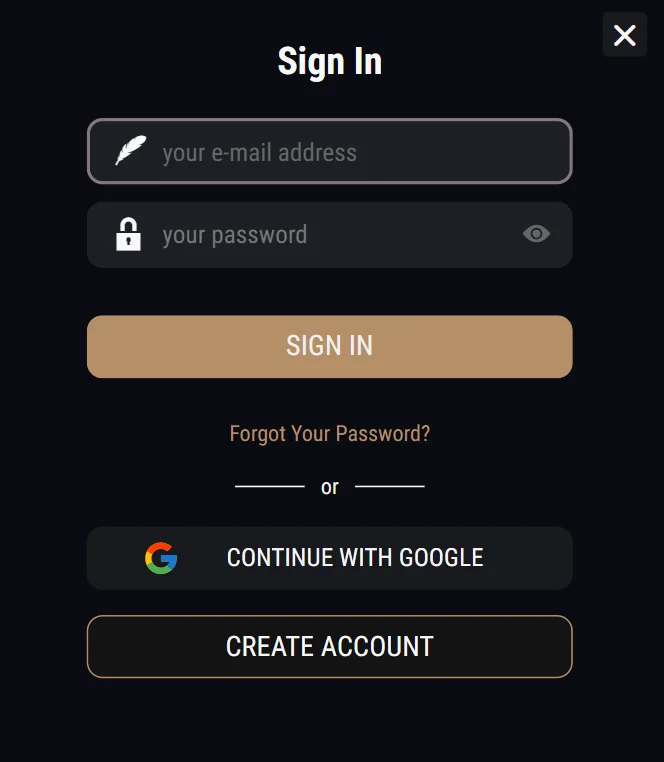
Reaching the Sign-In Panel on Desktop and Handheld Devices
The entry point sits in the same place on every screen size: the top-right corner of the header. On a widescreen monitor you will see a dedicated button beside the registration prompt. On a phone, the header collapses into a burger menu, and the sign-in control usually appears as the first item once the menu expands. If you have landed here from a comparison site or a bonus review, start from the official homepage of King Billy Casino rather than a bookmarked deep link, because stale URLs are a surprisingly common cause of failed attempts.
Two credentials are all that is required in a standard flow: the email address tied to your profile and the password you set during registration. Some players register with a username instead, in which case the field accepts either. Nothing else is requested at this stage — no card details, no document uploads, no security questions. If a page ever asks for payment information simply to log you in, close the tab immediately and check the address bar, because that is the classic fingerprint of a cloned site.
Session behaviour differs between devices, and it is worth knowing which one you are on. Desktop browsers typically hold a session until you close the browser entirely or the inactivity timer expires. Mobile browsers running in the background are far more aggressive about dropping sessions to save memory, so re-entry prompts appear more often on a phone than on a laptop. That is normal, not a fault with your account.
Step-by-Step: From Homepage to Lobby in Under a Minute
The sequence below assumes an existing, verified account. If you have never completed identity checks, expect an extra prompt after step four — that part is covered in its own section further on.
- Open the official site in your browser and confirm the padlock icon is present in the address bar before typing anything.
- Select the sign-in control in the header. On mobile, expand the menu first.
- Enter the email address or username registered to the account. Watch for autocorrect capitalising the first letter on iOS — email fields are case-insensitive, but username fields sometimes are not.
- Type your password. Use the eye icon to reveal it if you are unsure; typing blind is the single biggest cause of repeat failures.
- Complete two-factor authentication if you have enabled it. The code is time-limited, so request a fresh one rather than reusing an old SMS.
- Confirm, and you will be dropped straight into the lobby with your balance visible in the header.
- Check the balance and any active bonus timer before you start playing. Wagering requirements often carry a countdown, and knowing where you stand avoids nasty surprises.
A practical tip for regular players: bookmark the homepage rather than the login page itself. Login URLs are frequently rotated for security and load-balancing reasons, and a bookmark pointing at an old one produces a blank screen that looks far more alarming than it actually is.
Reading Error Messages Properly Instead of Guessing
Failed sign-ins almost always come with a message, and those messages are more informative than most players assume. The trouble is that they are written in generic language, so a genuinely minor issue reads like an account ban. The table below translates what appears on screen into what is actually happening behind it, along with the fix that resolves it fastest.
| What you see on screen | What it usually means | Fastest resolution | Typical time to fix |
|---|---|---|---|
| Incorrect email or password | A typo, a saved credential from an older account, or caps lock left on | Reveal the password field and retype manually rather than relying on autofill | Under a minute |
| Account temporarily locked | Too many failed attempts in a short window — an automatic brute-force defence | Wait out the cooldown period, then use password recovery instead of guessing again | 15–30 minutes |
| Verification required | Identity documents were never submitted or have been flagged as expired | Upload a current photo ID and a recent proof of address through the account area | Several hours to two business days |
| Session expired, please sign in again | Inactivity timeout, or the browser dropped the session in the background | Simply sign in again; nothing on the account has changed | Immediate |
| Page will not load at all | Network-level blocking, DNS caching, or an outdated bookmarked URL | Clear the browser cache and reach the site from the current homepage address | A few minutes |
| Account closed or self-excluded | A self-exclusion or closure request has been applied to the profile | This is intentional and cannot be reversed on request during the exclusion period | Not reversible early |
Notice the pattern: only two of these six situations involve anything wrong with your account. The rest are browser behaviour or deliberate safety mechanisms doing their job. Before contacting support, work down the table and rule out the quick fixes — it saves waiting in a live chat queue for something a cache clear would have solved.
Recovering a Password Without Locking Yourself Out Further
Password recovery is where players tend to make things worse. The instinct after a failed attempt is to try three or four variations, which triggers the lockout defence and adds half an hour to the process. The better move is to stop after the second failure and go straight to recovery.
Select the recovery prompt beneath the password field, enter the email address on the account, and wait for the reset link. Delivery is usually fast, but check the junk folder before assuming nothing arrived — Australian mail providers filter gambling-related senders aggressively. Reset links are single-use and time-limited, generally expiring within an hour, so request a fresh one rather than clicking yesterday’s email.
When you choose the replacement password, avoid anything derived from your name, birth year, or the site itself. A short passphrase of unrelated words is both stronger and easier to remember than a scrambled eight-character string. Better still, let a password manager generate and store it, so the credential never lives in your head or in a note on your phone.
If the recovery email genuinely never arrives after two attempts, the likely explanation is that the address on file differs from the one you are typing — often an old work address or a typo made during registration. At that point support is the right call, and having your registered full name and date of birth ready will speed the identity check considerably.
Hardening Your Account Against Unauthorised Access
Offshore platforms sit outside Australian consumer protections, which raises the stakes on personal security. If someone gets into your account, the recourse available to you is far narrower than it would be with a domestic, state-licensed wagering operator. That makes prevention the whole game.
A few habits do most of the heavy lifting:
- Enable two-factor authentication the moment it is offered, and prefer an authenticator app over SMS where the option exists.
- Never sign in over public Wi-Fi at a pub, airport, or shopping centre without a trusted VPN in place.
- Use a password that appears nowhere else in your digital life, particularly not on your email account.
- Turn off password autofill on any device that other people use, including a shared family tablet.
- Review your account activity log periodically for sessions from unfamiliar locations or devices.
- Sign out deliberately rather than just closing the tab when you are finished for the night.
Your email account deserves particular attention, because it is the master key. Anyone with access to your inbox can trigger a password reset and walk straight through the front door. Securing the inbox with its own two-factor authentication is arguably more important than securing the gaming account itself.
Phishing remains the most effective attack on players, and it rarely looks crude any more. Messages arrive styled like genuine promotional emails, complete with matching typography and a plausible bonus offer, and the link points to a domain one character different from the real one. Our rule of thumb is simple: never sign in from a link in an email. Type the address yourself or use your own bookmark, every single time.
How Verification Shapes Your Access and Your Withdrawals
Know Your Customer checks are the point where many accounts stall. You can typically register and deposit before verifying, but the requirement surfaces the moment you request a payout — and sometimes earlier, if the platform’s risk system flags something. Getting it done early removes the friction entirely.
Documents commonly requested include a current photo ID such as an Australian driver licence or passport, a proof of address dated within the last three months, and occasionally proof of the payment method used for deposits. Photograph the whole document flat, in daylight, with all four corners visible and no glare across the details. Blurred edges and cropped corners are the reason most submissions get bounced back for a second attempt.
Once verification is complete, sign-in behaviour usually becomes smoother: fewer additional challenges, faster payout processing, and less chance of an unexplained hold. It is a one-off inconvenience that pays for itself the first time you cash out.
Where the Sign-In Experience Delivers and Where It Falls Short
No account system is flawless, and pretending otherwise does not help anybody make a decision. Here is a balanced read on what works well and what deserves caution.
On the positive side:
- The flow is genuinely short — two fields and a confirmation, with no unnecessary steps padding it out.
- Mobile browsers are supported directly, so there is no app install required to reach your account.
- Two-factor authentication is available for players who want a stronger perimeter.
- Session timeouts are enforced, which protects anyone who walks away from a shared computer.
- Password recovery is self-service and does not require contacting support in most cases.
On the other side of the ledger:
- Because the operator sits offshore, Australian regulators cannot help you resolve an access or payout dispute.
- Domain changes and access blocks can make the site unreachable without warning.
- Verification requests can appear mid-session and freeze withdrawals until documents clear.
- Support response times vary by time of day, and Australian evenings do not always align with peak staffing.
- Self-exclusion applied here does not connect to BetStop, so it covers this platform only.
That last point is the one we would underline hardest. A player who self-excludes on an offshore site remains able to open accounts elsewhere, which is precisely the gap that Australia’s national register was designed to close for licensed operators.
What Australian Player Support Patterns Reveal About Failed Sign-Ins
Looking across the access problems that Aussie players actually report, a consistent shape emerges — and it is not the one most people expect. The overwhelming majority of failed attempts have nothing to do with the account being restricted, banned, or compromised. They come down to three mundane causes: credentials saved on a device that has since been replaced, browsers holding onto outdated cached versions of the site, and verification steps that were started but never finished.
The seasonal pattern is telling too. Access complaints spike after long breaks — the fortnight following Christmas, and again after the winter footy season winds down. Players who have not signed in for six weeks return to find their saved password no longer works, usually because a browser update wiped the stored credential rather than because anything changed on the account. Recognising this pattern turns a moment of panic into a routine password reset.
There is a wider market context worth holding in mind as well. Australian gambling participation skews heavily towards wagering on racing and sport, both of which are legally available through domestically licensed operators regulated by bodies such as Liquor & Gaming NSW and the Victorian regulator. Online casino play does not sit in that legal category. Players who take the time to understand this distinction tend to make better-informed decisions about where they hold accounts and how much protection they can realistically expect if something goes wrong.

Regulation, Self-Exclusion and Playing Within Sensible Limits
Access to your account should always be paired with control over it. Australia has a national self-exclusion register, BetStop, which blocks registration and sign-in across all Australian-licensed interactive wagering services for the period you nominate. It is free, it takes minutes, and it works at the operator level rather than relying on your own willpower each night.
If gambling has stopped being entertainment and started being a problem, free and confidential support is available around the clock through Gambling Help Online. Counsellors are available by chat and phone, and the service exists for family members as well as players themselves.
A few practical guardrails worth setting up the same day you set up your login: decide a deposit ceiling for the month before you sign in rather than during a session, keep gambling funds in a separate account from bills and rent, set a phone timer for session length, and never sign in to chase a loss. Every one of those is easier to enforce at a calm moment than at eleven at night after a rough run.
Account access is restricted to adults aged 18 and over. Gambling carries real financial risk, no strategy overcomes the built-in house edge, and no outcome in a casino game is owed to you because of what happened previously.
Sign-In Questions Aussie Players Send Us Most Often
Why does my session drop far more often on my phone than on my laptop?
Mobile operating systems aggressively reclaim memory from background browser tabs, which quietly terminates active sessions to keep the handset responsive. Desktop browsers hold sessions far longer because memory pressure is lower. Nothing is wrong with your account when this happens — you simply need to sign in again. Enabling a password manager on your phone makes the repeated re-entry far less irritating.
Can I have two accounts if I want to keep bonus play separate from my regular balance?
No. Duplicate accounts are prohibited across essentially every operator, and they are detected through matching payment details, IP addresses, and device fingerprints. The consequence is usually confiscation of balances on both profiles rather than a warning, and it complicates any future verification. If you want separation between bonus play and regular play, use the account’s own transaction history and set personal limits instead.
What should I do if my password reset email never turns up?
Check the spam and promotions folders first, because Australian mail providers filter gambling-related senders heavily. If it is genuinely absent after two requests spaced a few minutes apart, the address on the account almost certainly differs from the one you are entering — commonly an old work address or a registration typo. Contact support with your full name and date of birth ready so the identity check moves quickly.
Does signing in from a different state or on holiday cause problems?
A location change can trigger an additional security challenge, which is a protective feature rather than a fault. You may be asked to confirm a code sent to your registered email or phone. Where things get more complicated is international travel, since access rules differ by jurisdiction and a platform available in one country may be unreachable in another. Plan for the possibility that you simply cannot reach your account abroad.
How long does verification usually take once I have uploaded my documents?
Clear, well-photographed documents are typically reviewed within one to two business days, though busy periods stretch that out. The single biggest delay is resubmission caused by poor image quality — cropped corners, glare across the licence number, or a proof of address older than three months. Photograph everything flat in natural light with all four corners in frame and you will usually clear it first time.
If I self-exclude on this platform, am I covered everywhere else too?
No, and this is an important distinction. Self-exclusion applied on an offshore platform covers that operator alone. Australia’s national register operates across domestically licensed interactive wagering services, so it does not extend to sites outside that framework. If you want broad protection, register with the national scheme directly and consider bank-level gambling transaction blocks, which most major Australian banks now offer through their apps.